SLA, DLP, and LCD are the three main light-curing (photopolymerization) 3D printing technologies. All use UV light to solidify liquid resin layer by layer, but they differ significantly in light source, imaging method, speed, accuracy, cost, and suitability for dental applications. Understanding these differences helps clinics and laboratories choose the right system for models, surgical guides, temporary restorations, and orthodontic appliances.
1. Technology Principle & Light Source
SLA (Stereolithography)
Uses a UV laser (typically 355 nm or 405 nm) directed by galvanometer mirrors. The laser scans the resin surface point by point to draw each layer's contour ("point → line → surface"). After each layer, the build platform moves and the process repeats.
DLP (Digital Light Processing)
Uses a digital projector as the light source. The sliced layer image is projected as a complete 2D image onto the resin surface in one flash. The entire layer cures simultaneously. After curing, the platform moves for the next layer.
LCD (Liquid Crystal Display)
Similar principle to DLP, but replaces the projector with an LCD screen as the mask. UV LEDs (usually 405 nm) shine through the LCD panel, which selectively blocks or transmits light according to the layer image. Modern dental LCD printers often use high-resolution mono screens combined with uniform COB or parallel LED light sources for better intensity and consistency.
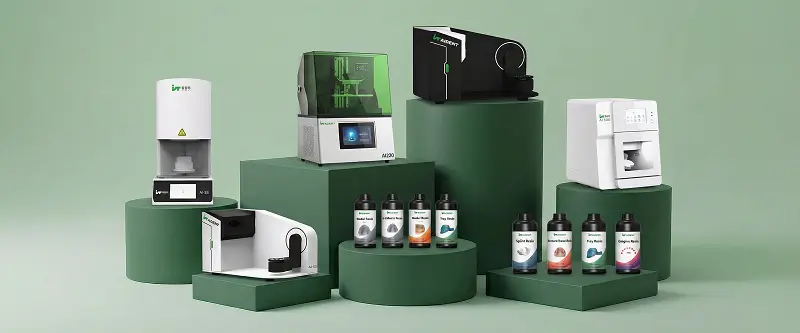
Aident's Ai-C60 and Ai220 dental 3D printers are advanced LCD systems featuring high-resolution screens, intelligent light sources (COB or AI LED parallel light), auto-leveling, and intelligent temperature control, delivering professional dental performance at accessible cost.
2. Printing Speed
DLP: Fastest of the three for most parts because the entire layer is cured at once.
LCD: Very close to DLP in speed when using high-intensity, uniform light sources and optimized resins. Modern mono-LCD dental printers achieve excellent productivity (e.g., single crowns in ~10 minutes and full-arch models in ~25 minutes under optimized conditions).
SLA: Slowest, because the laser must trace every point of the layer.
For high-volume dental labs or chairside same-day workflows, well-designed LCD and DLP systems offer clear speed advantages over traditional SLA.
3. Accuracy & Surface Quality
All three technologies can reach micron-level precision when properly engineered.
SLA: Excellent edge definition because the laser is a focused beam. Historically considered the gold standard for ultra-fine detail.
DLP: High accuracy, but older systems could show slight pixel or edge softening due to the projected light field. High-end modern DLP machines minimize this.
LCD: Accuracy is strongly tied to screen resolution (4K, 6K, 8K, or higher) and light uniformity. Current professional dental LCD printers routinely achieve ±0.03 mm accuracy with smooth surfaces and sharp margins when paired with high-precision dental resins.
In practice, for dental models, surgical guides, and temporary restorations, well-calibrated LCD systems (such as Aident Ai-C60/Ai220) deliver the accuracy and surface quality required for clinical and laboratory use.
4. Equipment Cost & Component Longevity
SLA: Highest cost due to precision laser and galvanometer systems. Suitable for high-budget specialized applications.
DLP: Mid-to-high cost. Projector modules are more expensive than LCD screens.
LCD: Most cost-effective. The LCD screen is a relatively low-cost consumable. Early screens had limited UV resistance, but modern mono screens and optimized optical designs significantly extend service life. Replacement screens are affordable, making long-term ownership economical for clinics and labs.
Aident LCD printers are engineered for dental production environments, balancing high performance with practical running costs and open-system flexibility.
5. Typical Application Fit in Dentistry
| Technology | Best Suited For | Limitations in Dental Use |
|---|---|---|
| SLA | Ultra-high-precision specialty models | Slower, higher cost |
| DLP | Speed + accuracy balance (labs, jewelry) | Higher equipment cost |
| LCD | High-volume models, guides, temporaries, chairside | Screen is a consumable (modern ones last much longer) |
Today's professional dental LCD printers have largely closed the historical performance gap with DLP while remaining more accessible. Combined with matched high-precision resins (model, surgical guide, temporary, castable, gingiva), they support efficient Scan → Design → Print workflows.
Summary Recommendation for Dental Professionals
Choose SLA when absolute maximum edge sharpness is required and budget is not a constraint.
Choose DLP when maximum layer-flash speed is the top priority and investment level is higher.
Choose modern LCD (especially dental-optimized systems) for the best overall balance of accuracy, speed, cost, and productivity in everyday clinic and laboratory work.
Aident3D focuses on advanced LCD dental 3D printers (Ai-C60 and Ai220) precisely because they deliver the accuracy, speed, and cost-effectiveness that most clinics and labs need for diagnostic models, implant surgical guides, temporary restorations, and orthodontic applications - all within an open system compatible with quality dental resins.
Ready to evaluate the right photopolymerization technology for your practice or laboratory?
Explore Aident's LCD dental 3D printers, matched high-precision resins, and complete digital dentistry solutions at https://www.aident3d.com/.
Request technical specifications, sample print parameters, or a quotation:
WhatsApp +86 19311417410 | Email dongjiahao@aident.cc
Selecting the appropriate light-curing technology and matched materials is one of the most impactful decisions for improving accuracy, throughput, and clinical outcomes in modern digital dentistry.