The pandemic accelerated digital adoption across dentistry, but the results for laboratories have been uneven. Some labs emerged stronger with shorter delivery cycles, higher capacity, and better client retention. Others invested heavily and saw limited return.
This review summarizes the real patterns observed in dental laboratories after 2020–2022, drawing on measurable outcomes from successful upgrades and the common reasons many projects underperformed.
The Pressures Labs Faced After the Pandemic
Surging demand for faster turnaround as clinics tried to clear backlogs
Higher expectations for accuracy and consistency
Labor shortages and rising technician costs
Clients (clinics) becoming less tolerant of delays and remakes
Growing preference for digital file exchange over physical impressions and models
Many laboratories responded by purchasing scanners, printers, or both. The difference between success and disappointment usually came down to how the technology was implemented.
What Frequently Went Wrong
Buying equipment without redesigning the workflow
A new printer sitting idle or used only for occasional models does not improve delivery times.
Choosing closed or high-fee systems
Subscription costs and limited file compatibility created ongoing friction with clinic clients and internal design software.
Underestimating training and process change
Without clear standard operating procedures and short, practical training, teams continued old habits.
No baseline measurement
Labs that failed to track pre-upgrade delivery time, remake rate, and daily output could not demonstrate ROI and often lost internal support for the project.
Focusing only on hardware specifications
Extreme accuracy claims or large feature lists mattered less than reliability, ease of daily use, and batch stability in a production environment.
What Successful Labs Did Differently
Successful digital upgrades shared several practical characteristics:
They targeted a clear bottleneck (usually delivery cycle or remake rate)
They implemented a complete or near-complete digital chain rather than isolated machines
They prioritized open file formats and low ongoing software costs
They measured results within the first 90 days
They chose equipment that technicians could learn quickly and maintain easily
Real Outcome Example: Capacity and Delivery Improvement
In August 2025 a mid-sized dental laboratory in Shenzhen introduced the Aident Ai220 large-format dental 3D printer together with high-precision, low-warpage model resin. The lab already had digital design capability and used the printer to close the production loop for models and related work.
Results recorded after three months:
| Metric | Before | After | Change |
|---|---|---|---|
| Daily model output | ~30+ | 70+ | Approximately 2.5× |
| Average delivery cycle | 3–5 days | 1.5–2 days | 50%+ reduction |
| Precision-related remakes | 1–2 per 10 models | Near zero | Sharp drop |
| On-time delivery | Under pressure | 100% | Fully recovered |
| Customer satisfaction | ~75% | 98% | Significant rise |
| Client impact | 2 clinics lost | Both returned + 5 new | Net growth |
Technicians reported that new staff could operate the system independently after one day of training. Monthly maintenance time fell to under one hour. Labor cost associated with model production declined by roughly 20%.
The key factors were stable batch printing on a large platform, consistent dimensional accuracy from the matched resin, and an open system that fitted existing design software.
Practical Lessons for Labs Still Upgrading
Define the primary goal before purchasing (faster delivery, lower remakes, higher volume, or new service lines).
Prefer open-architecture scanners and printers that export and accept standard STL/PLY/OBJ files.
Pair hardware with resins proven for low warpage and production reliability.
Train for daily operation, not just initial setup.
Measure the same metrics before and 90 days after installation.
Start with the highest-volume, highest-pain indication (usually models) and expand later.
Recommended Foundation for Most Laboratories
High-accuracy lab scanner or reliable intraoral scanner input (open files)
Production-oriented 3D printer with adequate build volume and auto-leveling (Aident Ai-C60 or Ai220)
High-precision model resin with documented low warpage
Clear SOP for scanning, nesting, printing, and post-processing
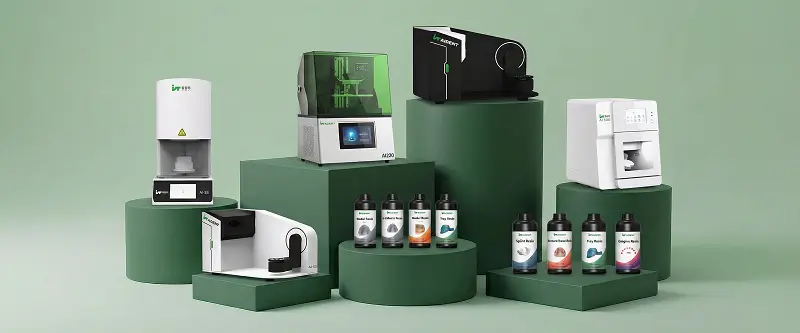
Aident's approach emphasizes complete, open digital solutions rather than isolated machines: lab scanners with <0.006 mm accuracy, Ai-C60 and Ai220 printers with <0.03 mm accuracy and open resin systems, and matching materials designed for daily production.
Moving Forward
Post-pandemic digital upgrades have rewarded laboratories that treated technology as a production system rather than a one-time purchase. Those that focused on workflow, openness, measurement, and ease of use have seen shorter delivery cycles, higher capacity, and stronger client relationships.
If your laboratory is planning or reviewing a digital upgrade, contact Aident for a practical productivity discussion, equipment recommendation, or demonstration.
WhatsApp: +86 19311417410
Email: dongjiahao@aident.cc
Inquiry: https://www.aident3d.com/inquiry
Real results come from matching reliable open equipment to clear operational goals - not from buying the most features.