Dental education has traditionally relied on extracted teeth, plaster models, and commercial teaching mannequins. While these tools remain useful, they have clear limitations in consistency, availability, customization, and cost when scaled across large student groups.
In recent years, more dental schools, universities, and professional training centers have adopted 3D printed dental models as a core teaching resource. The results are practical and measurable: higher training volume, better standardization, and improved student readiness for clinical work.
Limitations of Traditional Teaching Models
Extracted teeth vary widely in anatomy and condition
Plaster models are time-consuming to produce and easily damaged
Commercial typodonts and mannequins are expensive and limited in pathological variety
Difficult to create customized cases that match specific learning objectives
Storage and inventory management become burdensome at scale
These constraints often force educators to compromise between the number of practice opportunities and the quality or realism of the models.
Advantages of 3D Printed Teaching Models
Modern high-precision dental 3D printing addresses many of these issues:
1. Consistency and Standardization
Every student can receive identical copies of the same preparation, occlusion, or pathological case. This makes assessment fairer and feedback more objective.
2. Customization for Curriculum Needs
Educators can design or modify models to demonstrate specific situations - deep caries, different preparation designs, implant sites, orthodontic setups, or rare anatomical variations - and print them on demand.
3. High Volume at Controllable Cost
Once a digital library is established, producing dozens or hundreds of models becomes a repeatable production process rather than a manual bottleneck.
4. Dimensional Accuracy
When printed with high-precision model resin on a calibrated dental 3D printer, models maintain reliable margins, occlusal details, and overall geometry suitable for handpiece practice and evaluation.
5. Flexibility in Material and Use
Models can be printed for single-use practice or more durable versions for repeated demonstration, depending on the resin and post-processing chosen.
How the Digital Teaching Model Workflow Works
Digital source - CBCT data, intraoral scans, or designed CAD files of ideal or pathological cases
Design or modification - Adjust the model for the specific teaching goal (sectioning, removable parts, color coding, etc.)
3D printing - Produce the models in batch using a production-oriented dental printer
Post-processing - Wash, cure, and finish according to the resin requirements
Distribution and use - Students practice preparations, restorations, or treatment planning on standardized models
Equipment That Supports Educational Production
For institutions that want reliable, repeatable model output, the following combination is commonly used:
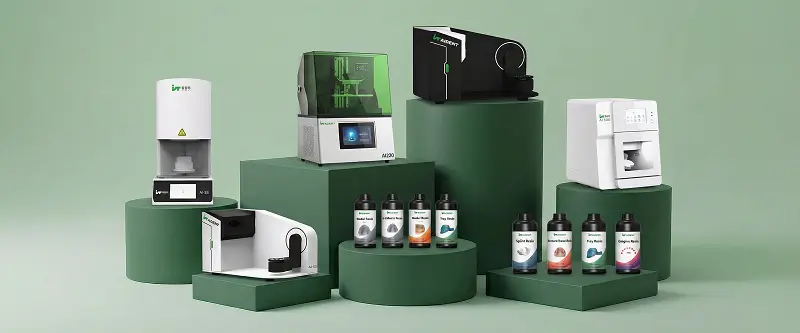
High-precision dental 3D printer (Aident Ai-C60 or Ai220)
Accuracy <0.03 mm
Auto-leveling and stable batch performance
Open resin system
Suitable for both small teaching runs and larger class volumes
High-precision model resin (Aident Model series / V2.0 type)
Ultra-low warpage (<0.4%)
Good surface detail and hardness for handling and preparation practice
Consistent results across multiple print jobs
Optional: laboratory scanner for digitizing existing physical models or reference cases into the digital library
Because the system is open, institutions can maintain their own digital case libraries and print on demand without proprietary lock-in.
Observed Educational Outcomes
Institutions that have integrated 3D printed models typically report:
Increased number of practice opportunities per student
More standardized skill assessment
Ability to introduce complex or rare cases earlier in the curriculum
Reduced dependence on limited extracted-tooth supplies
Better preparation of students for digital clinical workflows they will encounter after graduation
The same production advantages seen in commercial laboratories - higher daily output and shorter turnaround - also benefit teaching centers that need to supply models for entire cohorts on a fixed academic schedule.
Practical Recommendations for Dental Education Institutions
Start by digitizing or designing a core library of the most frequently used teaching cases.
Choose a printer and resin combination proven for dimensional stability and surface quality.
Establish clear post-processing and quality-check protocols so every model meets the same standard.
Train technical staff on nesting, printing parameters, and maintenance to keep production reliable.
Gradually expand the library to include advanced or specialty modules (implants, ortho, endodontics, etc.).
Supporting Dental Education with Reliable Production Tools
Aident provides open, production-ready 3D printing solutions used by laboratories and institutions that need accurate, repeatable dental models. The combination of Ai-C60 / Ai220 printers and high-precision model resins enables education centers to move from scarce, variable physical models to a scalable digital teaching resource.
Dental schools, universities, and training centers interested in 3D printed teaching models are welcome to contact us for equipment recommendations, resin information, or bulk/educational pricing discussions.
WhatsApp: +86 19311417410
Email: dongjiahao@aident.cc
Inquiry: https://www.aident3d.com/inquiry
Standardized, on-demand 3D printed models help educators focus on teaching - not on hunting for enough usable teeth or plaster models.