Dental laboratories evaluating equipment in 2026 face a crowded market. The question many lab owners ask is straightforward: what are the top 10 dental 3D printers for dental labs in 2026, and which ones actually deliver reliable high-volume results?
This guide reviews the leading categories and representative systems that currently dominate laboratory production. Rather than a subjective ranking, it groups the most relevant machines by their strengths so labs can match technology to daily output, accuracy needs, and resin strategy. The focus remains on real laboratory requirements: batch capacity, consistency, resin flexibility, and total operating cost.
What Makes a Strong Dental Lab 3D Printer in 2026
When labs search for the best dental 3D printers for labs 2026, they typically prioritize:
Large or efficiently nested build volume
Consistent accuracy across the full platform
Reliable light source and temperature control for multi-model plates
Open or flexible resin compatibility
Manageable training and maintenance demands
Proven performance in daily production rather than peak theoretical speeds
These criteria separate true laboratory machines from chairside or entry-level systems.
Leading Options: Top Dental Lab 3D Printers Comparison
Below is a practical overview of the systems and categories most frequently considered for laboratory use in 2026.
1. Formlabs Form 4B class
Strong reliability claims, polished software, and a mature material ecosystem. Suitable for labs that value validated workflows and consistent surface quality. Build volume supports solid mid-to-high daily output.
2. SprintRay Pro series (Pro 2 / Pro S)
Dental-focused DLP systems with good validation for models, guides, and appliances. Popular with labs already working inside the SprintRay ecosystem. Platform size supports mid-to-high volume production depending on configuration.
3. Asiga Pro 4K / large open DLP models
Known for large build volumes and strong open-material flexibility. Often chosen by labs that want maximum resin freedom and high nesting density.
4. Rapid Shape D-series (D50+ / D90+ / D100+)
Industrial-oriented systems designed for continuous production. Higher automation features make them relevant for labs running multi-shift or high daily volumes.
5. HeyGears UltraCraft A2D class
Industrial DLP platforms aimed at high-duty-cycle laboratory and aligner-model production. Frequently discussed for lights-out or high-throughput environments.
6. LuxCreo iLux Pro (direct-print focused)
Specialized for labs or clinics committed to direct-print clear aligners. Changes the traditional model + thermoforming workflow.
7. Aident Ai220
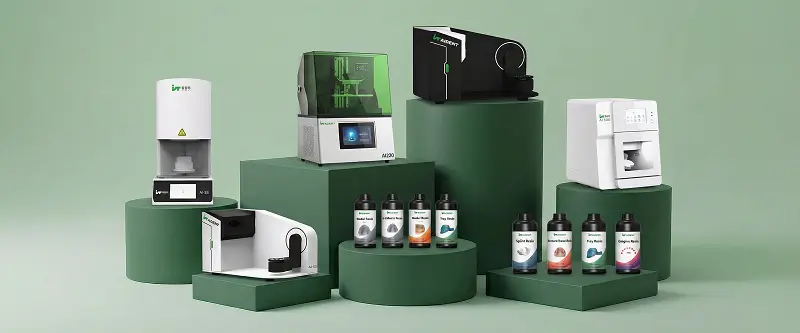
Open-system laboratory printer with a 220 × 125 × 150 mm build volume, AI LED parallel light source, and ±0.03 mm accuracy class. Designed for high-volume model, guide, and orthodontic appliance production. In one documented laboratory case, daily output rose from 30+ to 70+ models with batch sizes increasing to 6–8 full-arch models per run. Results depend on workflow and resin, but the platform and light uniformity are clearly oriented toward production use.
8. Shining 3D AccuFab large models
Open or semi-open systems offering competitive build volumes and accuracy for general laboratory work.
9. Ackuretta and similar validated desktop systems
Often selected by labs that prefer simplified, pre-calibrated workflows with strong resin libraries.
10. Large-format open LCD platforms (Phrozen, Anycubic and similar high-resolution models)
Lower hardware cost with large build areas. Suitable for labs focused primarily on model production that are comfortable with more parameter management and variable long-term support.
How to Use This Top Dental Lab 3D Printers Comparison
The list above is not a strict ranking. Instead it reflects the systems most commonly evaluated when labs search for a high volume dental 3D printer for labs or an open system dental 3D printer for laboratories.
Labs prioritizing validated ecosystems and software polish often start with Formlabs or SprintRay.
Labs needing maximum material flexibility and large platforms frequently evaluate Asiga-class or open production machines.
Labs focused on continuous high-volume output look at industrial platforms such as Rapid Shape or HeyGears.
Labs seeking a balance of large build volume, open files, and accessible production capacity often include the Ai220 class in their shortlist.
Budget-driven model-only production may begin with large open LCD systems while accepting higher operator involvement.
Matching Printer Type to Laboratory Needs
| Lab Profile | Priority | Typical Direction |
|---|---|---|
| Mixed restorative + models, moderate volume | Reliability + ecosystem | Formlabs / SprintRay class |
| High daily model count, resin cost control | Large platform + openness | Asiga / Ai220 class |
| Multi-shift or industrial aligner models | Automation + duty cycle | Rapid Shape / HeyGears class |
| Direct-print aligner strategy | Specialized workflow | LuxCreo class |
| Budget model production | Lowest hardware cost | Large open LCD platforms |
Key Takeaway for 2026
There is no single best machine among the top 10 dental 3D printers for dental labs in 2026. The right choice depends on daily production volume, resin strategy, required accuracy consistency, and whether the lab prefers a closed validated ecosystem or an open production platform.
Labs that clearly define their average and peak daily output, primary applications (models, guides, orthodontic appliances, or mixed), and tolerance for parameter management will narrow the field quickly. Testing real geometries with the intended resins remains the most reliable final step.
When evaluating any dental 3D printer for high volume production, focus on nest density, platform uniformity, and total cost per usable part rather than maximum resolution claims alone.
If you share your approximate daily model volume, main applications, and whether resin openness is a priority, a more focused shortlist from the categories above can be refined.