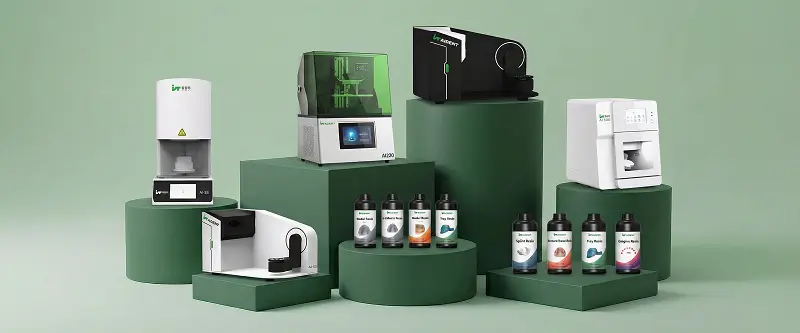
A dental 3D printer is a specialized additive manufacturing machine designed to produce accurate physical models, surgical guides, temporary restorations, orthodontic appliances and related dental objects from digital designs. Unlike general-purpose desktop 3D printers, dental systems are optimized for the precision, surface quality, material biocompatibility requirements and workflow needs of dental laboratories and clinics.
This article explains the core technology, the main machine types used in dentistry, and the practical steps from a digital file to a finished printed object.
What Is a Dental 3D Printer?
A dental 3D printer builds objects layer by layer using light-sensitive resin (photopolymer) that hardens when exposed to specific wavelengths of light, most commonly in the 385–405 nm range. The process starts with a 3D digital design (usually an STL file) created in dental CAD software from intraoral or laboratory scan data.
The printer's role is to translate that digital design into a physical object with sufficient accuracy and surface detail for dental use. After printing, the object typically requires washing to remove residual resin and post-curing to achieve final mechanical properties.
Dental 3D printers are used for both non-patient-contact items (diagnostic models, working models) and patient-contact or short-term intraoral items (surgical guides, temporary crowns, occlusal splints), provided the appropriate certified resins and validated workflows are used.
How Dental 3D Printing Technology Works
Most dental 3D printers use vat photopolymerization. The basic principle is:
A build platform is positioned just above or in contact with a vat of liquid photopolymer resin.
A light source projects or masks a cross-sectional image of the current layer onto the resin surface (or through a transparent vat bottom).
The exposed resin solidifies (cures) in the shape of that layer.
The build platform moves by a defined layer thickness, and the next layer is cured.
The process repeats until the full object is complete.
The cured object remains attached to the build platform and is later removed for post-processing.
Two factors are especially important in dental applications:
Dimensional accuracy and repeatability – critical for fit of models, guides and restorations.
Surface quality and detail reproduction – affects both aesthetics and functional performance.
Main Types of Dental 3D Printers
Three light-curing technologies dominate dental use:
LCD / mSLA (Masked Stereolithography)
An LCD screen acts as a mask between a UV LED array and the resin. The screen selectively blocks or transmits light to form each layer image. Modern dental LCD printers are widely used because of relatively lower cost, good resolution and improving reliability. The LCD panel is a consumable that degrades over time.
DLP (Digital Light Processing)
A digital projector (usually based on a DMD chip) flashes a complete layer image onto the resin in one exposure. DLP systems are often valued for consistency of light across the build area and long optical life. They are common in both laboratory and higher-end production environments.
SLA (Laser Stereolithography)
A laser beam is steered by galvanometers to draw each layer point by point or in vectors. Traditional SLA can deliver high surface quality; some systems remain in use for specific dental applications, though LCD and DLP have become more prevalent for many model and guide workflows.
Hybrid or proprietary variations exist, but the majority of current dental resin printers fall into the LCD or DLP categories.
Key Components of a Typical System
A professional dental 3D printer generally includes:
Build platform (often with automatic or assisted leveling).
Resin vat with transparent bottom (for bottom-up systems).
Light engine (LED array + LCD, or DLP projector, or laser).
Motion system (Z-axis and sometimes additional axes).
Control electronics and touchscreen or computer interface.
Resin temperature management in higher-end systems.
Enclosure for light safety and environmental stability.
Software components include the printer's native control software and, more importantly, the slicing software that converts the STL design into layer-by-layer instructions (including supports, orientation and exposure parameters).
The Complete Digital Workflow
A typical sequence from scan to finished object is:
Data acquisition – Intraoral scanner or laboratory scanner captures the patient's or model's geometry.
CAD design – Dental CAD software is used to design the model, guide, temporary restoration or appliance. The design is exported as an STL (or similar) file.
Preparation and slicing – The file is oriented, supported and sliced with parameters matched to the specific printer and resin.
Printing – The prepared file is sent to the printer and the object is built layer by layer.
Washing – Residual uncured resin is removed, usually with isopropyl alcohol or a dedicated washing solution.
Post-curing – The object is exposed to additional UV light (and sometimes heat) to reach final mechanical properties and biocompatibility where required.
Finishing – Supports are removed, surfaces are smoothed if needed, and the object is prepared for its intended use.
The quality of the final result depends on the entire chain - scan accuracy, design quality, printer performance, resin properties and correct post-processing - not on the printer alone.
Common Applications in Dentistry
Dental 3D printers are routinely used for:
Diagnostic and working models
Implant surgical guides
Temporary crowns and bridges
Occlusal splints and night guards
Orthodontic models and indirect bonding trays
Castable patterns for metal frameworks
Custom impression trays and try-in appliances
The specific resin must be matched to the indication. Model resins, surgical-guide resins, temporary restoration resins and castable resins have different mechanical and biological requirements.
Limitations and Practical Considerations
Dental 3D printing is powerful but not universal:
Accuracy depends on calibration, resin condition, orientation, support strategy and post-processing.
Not every printer–resin combination is suitable for every indication.
Post-processing (wash and cure) is mandatory and affects final properties.
Open systems offer material flexibility; closed systems may simplify validation but can increase material cost and dependency.
Operator training and process discipline remain important for consistent results.
Buyers should evaluate printers on real dental sample performance rather than isolated resolution specifications.
FAQ
What is the difference between a dental 3D printer and a regular resin 3D printer?
Dental systems are typically optimized for higher accuracy, better light uniformity, dental-specific software workflows, and compatibility with validated dental resins. They also more commonly carry medical-device related documentation.
Do I need special software?
You need dental CAD software to create the designs and slicing software (often supplied with the printer or available as third-party tools) to prepare the print job. Many printers accept standard STL files.
How accurate are dental 3D printers?
Professional systems used for models and guides commonly target accuracy in the range of tens of microns under controlled conditions. Real-world results depend on the complete process. Always validate with application-specific samples.
Is post-curing always necessary?
Yes for almost all dental resins. Proper post-curing is required to achieve the mechanical strength and, where relevant, the biocompatibility stated by the resin manufacturer.
Can one printer handle all dental applications?
Many printers can handle a range of applications when paired with the correct resins and parameters. High-volume laboratories sometimes use multiple machines optimized for different tasks.
Next Steps
Understanding how a dental 3D printer works is the foundation for evaluating specific machines, resins and workflows. When comparing systems, focus on demonstrated accuracy for your intended applications, resin flexibility, reliability, support quality and total process requirements rather than marketing specifications alone.
If you are exploring dental 3D printers as part of a complete digital workflow (scan → design → print), you can review detailed product information or request technical discussion through the manufacturer's official channels.