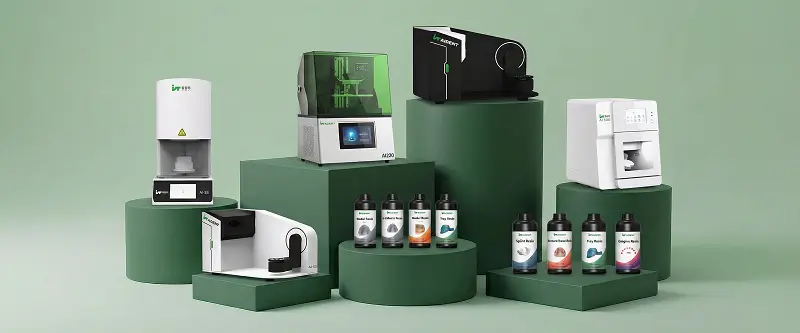
Dental 3D printers are used to produce a wide range of physical objects that support diagnosis, treatment planning, surgical procedures and restorative or orthodontic work. The most common outputs are models, guides and temporary appliances made from specialized dental resins.
Below are 15 of the most frequently produced items in dental laboratories and clinics. The exact suitability of any application depends on the printer's accuracy, the resin used, and correct post-processing (washing and curing).
1. Diagnostic Models
Physical representations of the patient's dentition used for examination, treatment planning, patient communication and record keeping. These are among the highest-volume applications in most laboratories.
2. Working Models
More durable models used during the fabrication of restorations or appliances. They serve as the physical base on which technicians build or verify work.
3. Implant Surgical Guides
Guides that help the surgeon place implants at the planned position, angle and depth. These require high accuracy and are typically printed with rigid, biocompatible surgical-guide resins that can be sterilized according to validated protocols.
4. Temporary Crowns and Bridges
Provisional restorations that protect prepared teeth and maintain function and aesthetics while the final restoration is being made. Printed temporaries are produced from resins designed for short-term intraoral use.
5. Occlusal Splints and Night Guards
Hard or semi-rigid appliances used for managing bruxism, protecting teeth, or repositioning the jaw. These are commonly printed and then finished for patient comfort.
6. Orthodontic Models
Models used for orthodontic diagnosis, treatment planning, appliance design and progress records. High geometric accuracy is important for proper analysis and appliance fit.
7. Indirect Bonding Trays
Transfer trays that allow orthodontists to place multiple brackets in predetermined positions. The trays are printed from flexible or semi-flexible materials suited to this purpose.
8. Clear Aligner Thermoforming Models
Positive models over which clear aligner sheets are thermoformed. These models must be accurate and dimensionally stable so that the finished aligners fit correctly.
9. Castable Patterns
Patterns printed in castable (burnout) resin that are invested and cast in metal or pressed in ceramic. They replace traditional wax patterns for crowns, bridges and partial denture frameworks.
10. Custom Impression Trays
Individual trays designed for more accurate impressions, especially in complex or edentulous cases. Printed trays can be made quickly from suitable rigid resins.
11. Try-In Dentures and Setups
Preliminary denture bases or tooth setups used to verify fit, occlusion, aesthetics and phonetics before final processing. These allow adjustments to be made early in the process.
12. Gingiva Masks
Soft or flexible gingival simulations added to implant or restorative models so that soft-tissue contours can be evaluated and emergence profiles designed more accurately.
13. Implant Models with Analog Replicas
Models that incorporate implant analog positions for the fabrication of custom abutments, crowns or full-arch restorations on implants. Accurate analog placement is critical.
14. Diagnostic Wax-Ups (Digital)
Physical versions of digitally designed wax-ups used to show proposed restorative or aesthetic changes to the patient and to guide preparation or provisionalization.
15. Retainers and Other Removable Appliances
Certain retainers and similar removable appliances can be printed directly when appropriate flexible or rigid resins and validated workflows are used. (Many retainers are still thermoformed over printed models.)
Important Notes on Resins and Workflows
Not every resin is suitable for every application.
Model resins are optimized for accuracy, surface detail and stability.
Surgical-guide resins must meet biocompatibility and sterilization requirements.
Temporary restoration resins need adequate strength and wear characteristics for short-term intraoral use.
Castable resins are formulated for clean burnout.
Flexible resins are used for gingiva masks, certain trays and some appliances.
Correct orientation, support strategy, washing and post-curing are essential. A high-quality printer alone does not guarantee good results if the resin or post-processing is incorrect.
How Laboratories and Clinics Typically Use These Applications
Laboratories usually focus on high-volume model production, surgical guides, castable patterns, aligner models and complex restorative models.
Clinics with chairside capability often print diagnostic models, surgical guides, temporary restorations and splints for same-day or rapid turnaround work.
Many practices combine both: intraoral scanning in the clinic and centralized or in-house printing for the required objects.
The decision of which applications to offer depends on equipment capability, resin availability, staff training and local regulatory requirements for patient-contact devices.
FAQ
Can one dental 3D printer handle all 15 applications?
Many professional printers can cover a wide range of applications when paired with the appropriate resins and parameters. High-volume laboratories sometimes use multiple machines optimized for different tasks (for example, one for models and another for guides or temporaries).
Are all printed dental objects biocompatible?
No. Only resins that have been tested and certified for the specific intended use (and processed according to the manufacturer's instructions) should be used for intraoral applications. Model resins are generally not for patient contact.
How accurate do printed surgical guides need to be?
Surgical guides require high dimensional accuracy and stability. Always validate the complete workflow (scan, design, print, post-process) for the specific printer and resin combination being used.
Is 3D printing replacing traditional model pouring completely?
In many laboratories digital models have significantly reduced or replaced stone models for numerous indications. Traditional methods remain in use for certain cases or preferences.
What limits the applications a printer can support?
Build volume, accuracy, resin compatibility, software workflow, post-processing equipment and regulatory status of the materials are the main practical limits.
Next Steps
Understanding the range of possible applications helps laboratories and clinics prioritize which services to offer and which equipment capabilities matter most. When evaluating printers, focus on demonstrated performance with the specific applications you intend to produce, resin flexibility, reliability and the quality of technical support.
If you are exploring dental 3D printers as part of a broader digital workflow, you can review detailed equipment and resin information or request a technical discussion through the manufacturer's official channels.