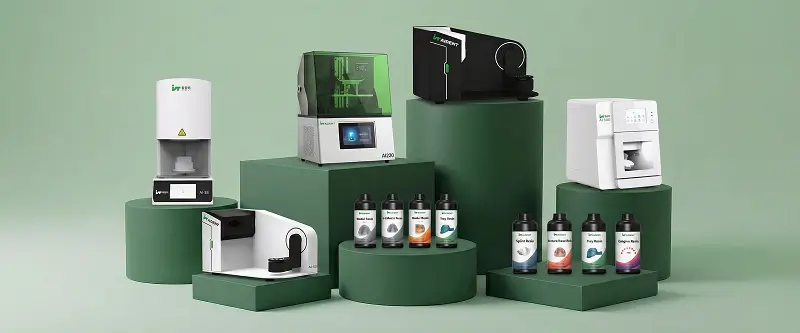
A dental 3D scanner is a device that captures precise three-dimensional digital models of teeth, oral tissues, dental models, or impressions. These digital models form the foundation of modern digital dentistry workflows, enabling accurate design, manufacturing, and communication without relying solely on traditional physical impressions or plaster models.
Dental 3D scanners are now essential tools in both clinics and laboratories.
Types of Dental 3D Scanners
There are two primary categories:
1. Intraoral Scanners (Chairside)
Handheld devices used directly in the patient's mouth to create digital impressions.
They capture teeth, gingiva, and occlusion in real time and are widely used for crowns, bridges, implants, aligners, and diagnostic records.
2. Laboratory (Desktop) Scanners
Stationary scanners used in dental laboratories to digitize plaster models, impressions, wax-ups, and implant models.
They typically offer very high accuracy and speed for production environments and handle high daily volumes of cases.
Both types produce digital files (commonly STL, PLY, or OBJ) that feed into CAD software for design and subsequent manufacturing by milling machines or 3D printers.
How Dental 3D Scanners Work
Most systems use optical technology, primarily structured light:
A light pattern is projected onto the object (teeth or model).
Cameras capture the deformation of the pattern.
Software calculates precise 3D coordinates and reconstructs a detailed digital surface.
Color information is often captured simultaneously for realistic visualization.
Intraoral scanners perform this process inside the mouth in real time. Laboratory scanners do it on stable models or impressions under controlled conditions, often achieving higher consistency for complex or high-volume work.
Why Dental 3D Scanners Are Important for Digital Dentistry
1. They Replace or Reduce Traditional Impressions
Digital scanning eliminates many of the limitations of physical impression materials - distortion, voids, patient discomfort, and the need to pour stone models.
2. They Enable Fully Digital Workflows
Scan data flows directly into CAD software for designing crowns, bridges, implant restorations, dentures, surgical guides, and aligners, then on to CAM manufacturing (milling or 3D printing).
3. They Improve Accuracy and Consistency
High-quality scanners deliver dimensional accuracy measured in micrometers. This supports better-fitting restorations, fewer adjustments, and lower remake rates when proper technique is used.
4. They Increase Efficiency and Capacity
Chairside: Faster impression taking and immediate review of data.
Laboratory: Full-arch models can be digitized in seconds to low tens of seconds, accelerating case intake and design start times.
5. They Enhance Communication
Digital models are easy to store, share with laboratories or specialists, and present to patients for treatment education and case acceptance.
6. They Support Advanced Applications
Implant planning, guided surgery, clear aligner therapy, digital dentures, and complex full-arch restorations all rely on accurate 3D scan data.
7. They Reduce Material Waste and Storage Needs
Fewer physical impressions and models mean lower material costs and less physical storage space.
Clinical and Laboratory Benefits at a Glance
| Benefit | Clinic Impact | Laboratory Impact |
|---|---|---|
| Patient comfort | Significantly improved | - |
| Speed | Faster chairside process | Higher daily case capacity |
| Accuracy & fit | Better-fitting restorations | More predictable production results |
| Remake reduction | Fewer chairside adjustments | Lower remake-related costs |
| Workflow integration | Direct digital path to design/manufacture | Seamless CAD/CAM connection |
| Data management | Easy storage and sharing | Efficient digital case handling |
| Future readiness | Foundation for digital growth | Scalable production platform |
What Makes a Good Dental 3D Scanner?
For intraoral scanners:
Accuracy, lightweight ergonomics, powder-free operation, effective anti-fog, sufficient depth of field, true-color imaging, open file export, and intuitive software.
For laboratory scanners:
High accuracy (often 4–8 μm range), fast full-arch scanning, clean data with minimal post-processing, strong multi-die and implant scan body performance, open architecture, and reliable daily production stability.
In both cases, open export of standard formats (STL, PLY, OBJ) is highly valuable because it preserves freedom to choose CAD software and manufacturing equipment.
Aident's Role in Digital Dentistry
Aident provides both categories of dental 3D scanners as part of a complete digital workflow:
Intraoral Scanners
AI-30: ≤10 μm accuracy, 156–198 g, powder-free true-color, open system
AI50: ≤7 μm accuracy, 145 g (with tip) / 130 g (without), 38 fps, AI smart report, CE & ISO certified
Laboratory Scanners
AI-S3 series: 6 μm accuracy (ISO 12836), approximately 10-second full-arch scans, AI-assisted features, fully open STL/PLY/OBJ export
These systems support clinics and laboratories in building efficient, open, and production-ready digital processes.
Conclusion
A dental 3D scanner is the essential gateway to digital dentistry. Whether used chairside as an intraoral scanner or in the laboratory as a desktop scanner, it converts physical oral structures or models into accurate digital data that drives design, manufacturing, and communication.
By improving accuracy, efficiency, patient experience, and workflow integration, dental 3D scanners have moved from optional technology to a core requirement for modern restorative, implant, orthodontic, and prosthetic practice.
Ready to strengthen your digital dentistry workflow with reliable 3D scanning?
Explore Aident intraoral and laboratory scanners
Contact us:
Inquiry form: https://www.aident3d.com/inquiry
WhatsApp: +86 19311417410
Email: dongjiahao@aident.cc
Digital dentistry begins with accurate 3D data. Choosing the right scanner sets the foundation for everything that follows.