


Traditional hand-waxing is rapidly becoming obsolete in modern dental labs. It is labor-intensive, highly dependent on individual skill, and costly when castings fail. 3D-printed wax resin is taking its place. By producing accurate digital patterns instead of hand-carved ones, labs achieve faster turnaround, greater consistency, and fewer remakes-while maintaining high casting quality.
Whether you operate a high-volume dental lab or supply materials to technicians, choosing the right dental castable photopolymer affects print reliability, burnout cleanliness, and final restoration fit. This guide covers what the material is, why labs are adopting it, how it fits digital workflows, key performance features, real applications, comparison with traditional methods, supplier selection criteria, and practical technical details.
What Is Wax Resin?
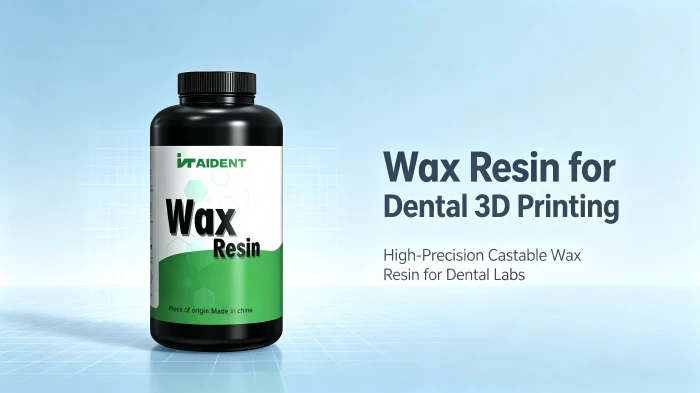
Wax resin is a specialized light-cure photopolymer designed for dental 3D printing followed by lost-wax casting or pressing. It contains a high proportion of burnable wax components and additives that allow the printed pattern to vaporize cleanly during burnout, leaving very low ash residue.
Typical process: CAD design → 3D print the pattern → burnout → metal casting or ceramic pressing → finished restoration.
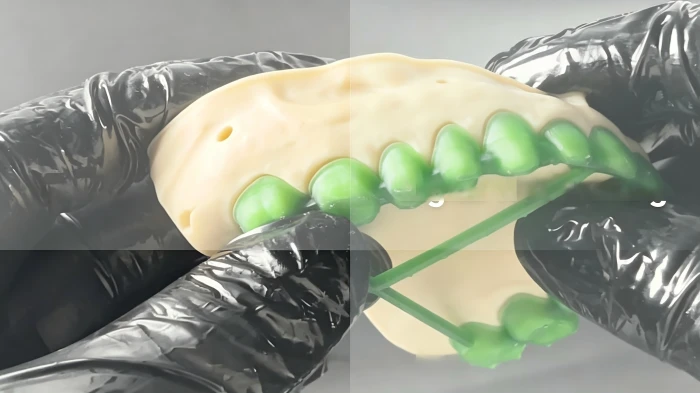
Unlike standard model resins or temporary crown materials, this clean burnout resin is engineered specifically for lost wax casting 3D printing. It produces reliable 3D printed wax patterns for crowns, bridges, implant work, and partial frameworks, and is compatible with common LCD, DLP, and SLA dental printers when the correct parameters are applied.
Why Dental Labs Are Switching to Castable Resin
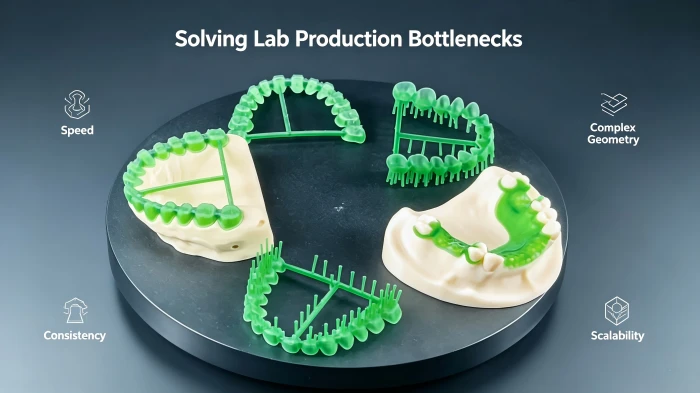
Faster and more repeatable production Manual wax carving requires experienced hands and frequent adjustments. Digital design followed by printing delivers consistent 3D printed wax patterns in hours rather than days. A design change can be reprinted quickly instead of starting over by hand.
Better accuracy and fewer failures Printed patterns provide precision margin adaptation and passive fit. This is especially valuable for crowns, bridges, implant restorations, and custom abutments, where small deviations often lead to remakes.
Lower overall costs Material waste decreases, dependence on highly skilled wax sculptors is reduced, and new technicians face a flatter learning curve. Batch production becomes realistic for labs looking to scale.
How It Works in a Digital Dental Workflow
- Design – Scanner data is imported into dental CAD software. The restoration is designed and the pattern exported as an STL file.
- Print – The file is sliced and printed on an LCD, DLP, or SLA system using parameters matched to the specific castable resin.
- Burnout and cast/press – A controlled temperature cycle ensures complete burnout with sub-0.1% ash residue, allowing clean metal casting or ceramic pressing.
When resin, printer settings, and burnout schedule are properly matched, the workflow becomes predictable and scalable.
Key Features of a High-Performing Castable Resin
| Feature | Practical Benefit |
|---|---|
| High dimensional accuracy | Precision margin adaptation and passive fit |
| Clean burnout | Fewer casting defects and inclusions |
| Low ash residue | Cleaner mold cavity and improved surface quality |
| Stable print performance | Consistent results from batch to batch |
| Broad printer compatibility | Works with most LCD, DLP, and SLA dental systems |
Consistency across batches often matters more than any single published specification. Labs need confidence that the same settings will perform reliably over time.
Common Applications in Dental Laboratories
- Crown and bridge patterns
- Implant crowns and custom abutments
- Partial denture frameworks
- Precision patterns requiring clean burnout for metal casting or ceramic pressing
These applications cover most fixed and removable work that still relies on the lost-wax process.
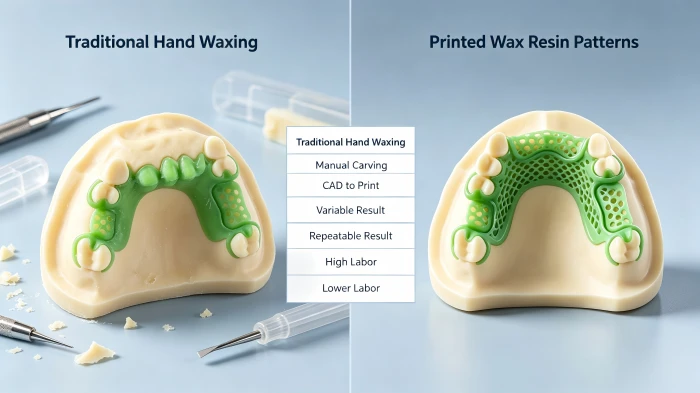
Printed Patterns vs Traditional Hand-Waxed Patterns
| Factor | Traditional Hand Wax | 3D-Printed Castable Resin |
|---|---|---|
| Speed | Slow | Fast |
| Accuracy | Depends on technician skill | Digitally controlled |
| Design changes | Time-consuming | Quick redesign and reprint |
| Batch capability | Limited | Practical for volume |
| Labor dependence | High | Lower |
Labs aiming for higher throughput without sacrificing quality almost always benefit from the printed approach.
How to Evaluate a Reliable Supplier
Focus on factors that influence long-term results:
- Formula stability and proven batch consistency
- Validated printing parameters for common dental printers
- Responsive technical support, including troubleshooting and application guidance
- ISO-aligned manufacturing, rigorous quality control, and dependable global supply capacity (including OEM/ODM options)
A supplier who provides clear burnout schedules, sample material, and real application data usually delivers more value than one competing only on price.
Products DescriptionTypical Technical Reference Points
| Item | Typical Specification |
|---|---|
| Material type | Dental castable photopolymer / wax resin |
| Primary use | Lost wax casting 3D printing and ceramic pressing |
| Compatible printers | LCD, DLP, SLA |
| Accuracy | Micron-level dimensional control |
| Burnout performance | < 0.1% ash content (clean burnout) |
| Burnout range | Typically 750°C – 850°C (1380°F – 1560°F); follow specific curve |
| Appearance | Wax-like color |
Example burnout schedule (illustrative only – always follow the manufacturer's recommended curve): Ramp at approximately 10°C/min (18°F/min) to 750°C (1380°F), hold for 60 minutes, then continue according to the alloy or ceramic requirements. Exact rates and hold times vary by resin and casting system.
Always request the current technical data sheet and the official burnout schedule. Formulations differ, and correct parameters matter more than generic claims. Searching for terms such as "best castable resin for dental 3D printer" or "burnout schedule for dental resin" often leads labs to suppliers who publish this level of detail.
FAQ
Q: What is wax resin mainly used for in dentistry?
A: It creates digital patterns for crowns, bridges, implant restorations, and partial frameworks that are later cast in metal or pressed in ceramic.
Q: Can it be printed on standard dental 3D printers?
A: Yes. Most quality formulations work with LCD, DLP, and SLA systems when the correct exposure and support settings are used.
Q: How does it differ from ordinary dental resins?
A: Ordinary model or temporary resins are not designed for clean burnout. Castable wax resin is formulated to leave minimal residue so the mold cavity stays clean.
Q: What should I look for in a manufacturer?
A: Consistent material performance, useful technical support, production capacity that matches your volume, and experience supplying dental labs internationally.

Why Leading Dental Labs Partner with Aident3D for Castable Solutions
Vivamus tortor risus,pharetra ut venenatis ac,rutrum eget anten fusce convallis nibh felis,eget hendrerit diam rhoncus rana miss dictum lacus eleifend nisl efficitur venenatis.
Aliquam eros justo,posuere loborti viverra laoreet matti ullamcper posuere viverra .Aliquam s justo,posuere so lobortis non,viverra laoreet posuere loborti Aliquam eros justo,posuere loborti viverra laoreet matti ullamcorper posuere viverra .Aliquam s justo,posuere so lobortis non,viverra laoreet posuere loborti
Next Step: Upgrade Your Casting Workflow
Selecting the right castable resin improves daily efficiency, reduces failed castings, and supports higher production volumes.
Request a Dental Castable Resin Sample


