Digital Light Processing (DLP) 3D printing has become one of the most important additive manufacturing technologies in digital dentistry. By projecting an entire layer of light at once onto liquid photopolymer resin, DLP enables fast, accurate, and highly detailed production of dental models, surgical guides, temporary restorations, and other clinical appliances.
How DLP 3D Printing Works and Its Core Advantages
In a DLP system, a digital projector (or high-resolution LCD screen in many modern dental printers) cures an entire cross-section of resin simultaneously. The build platform then moves, and the next layer is cured. This layer-by-layer process continues until the full 3D object is complete.
Key advantages for dental applications include:
High accuracy and fine detail reproduction
Fast printing speeds (entire layers cured at once)
Excellent surface quality with proper resins and parameters
Efficient material use and relatively low waste
Strong suitability for complex geometries common in dentistry
These characteristics make DLP (and closely related LCD technology) ideal for the high-volume, high-precision needs of dental clinics and laboratories.
Major Applications of DLP Technology in Dentistry
1. Dental Models
Traditional plaster models are fragile, bulky to store, and time-consuming to produce. DLP-printed models offer high dimensional accuracy, excellent surface detail, easy digital storage and reproduction, and superior durability. They are widely used for orthodontic planning, crown and bridge work, diagnostic setups, and clear aligner fabrication.
2. Surgical Guides
DLP printing produces highly accurate, biocompatible surgical guides that improve implant placement precision, reduce chair time, and support minimally invasive procedures. When paired with CBCT data and proper planning software, these guides enhance both safety and predictability.
3. Temporary Crowns, Bridges, and Provisionals
Chairside or laboratory DLP printers can produce temporary restorations with good aesthetics, strength, and fit in a short time. This supports same-day dentistry workflows and improves patient convenience.
4. Orthodontic Applications
DLP is extensively used to print models for clear aligner production and other orthodontic appliances. The ability to produce multiple stage models quickly and accurately has helped scale personalized orthodontic treatment.
5. Removable Partial Denture Frameworks and Patterns
Castable or high-temperature resins printed via DLP can create precise patterns for subsequent casting or pressing, reducing manual waxing work and improving consistency.
Challenges and Ongoing Progress
While DLP technology is already mature for many dental uses, continued development focuses on:
Expanding the range of biocompatible, high-performance resins (for longer-term provisionals, denture bases, etc.)
Further improving print speed, reliability, and ease of use for chairside environments
Optimizing post-processing workflows
Enhancing software integration with intraoral scanners and CAD systems
Aident's Approach to Dental DLP / LCD 3D Printing
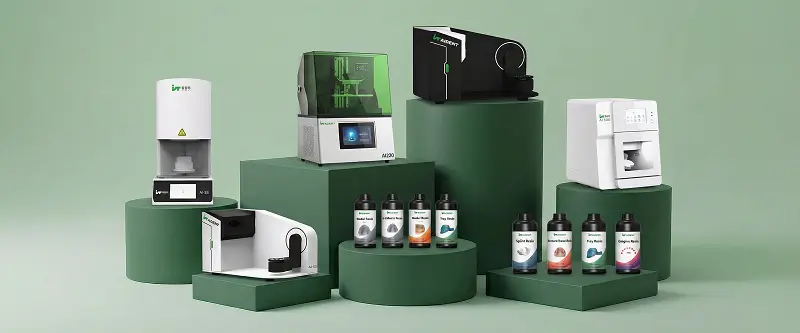
Aident3D designs its dental 3D printers (including the compact Ai-C60 and larger Ai220) specifically for clinical and laboratory dental workflows. Key features that support reliable DLP/LCD-style printing include:
High precision (typically ±0.03 mm)
Auto-leveling for consistent results
Intelligent temperature control
Built-in curing options on selected models
Open system compatibility with a wide range of dental resins
Fast full-arch model printing (approximately 25 minutes on the Ai-C60 under optimized conditions)
Matched Aident resins are available for models, surgical guides, temporary crowns and bridges, and castable applications, helping clinics and labs achieve predictable outcomes with lower remake rates.
Conclusion
DLP 3D printing has moved from an emerging technology to a practical, everyday tool in digital dentistry. It enables faster turnaround, higher accuracy, greater customization, and improved patient experience across models, guides, temporaries, and orthodontic applications.
When combined with accurate intraoral scanning and open CAD software, DLP printing forms a powerful part of the modern Scan → Design → Print workflow.
Ready to bring high-precision dental 3D printing into your clinic or laboratory?
Explore Aident's Ai-C60 and Ai220 printers and matched dental resins at https://www.aident3d.com/
Contact us for product details, demos, or technical support:
WhatsApp +86 19311417410 | Email dongjiahao@aident.cc